finance access
Availability and terms of capital or funding for an activity or institution.
Where the boundary lies
Existing revenue allocation is distribution or reinvestment, not necessarily access.
See an example → SUMMIT & RESEARCH
Which funding horizons, incentives and business models support sustained activity?
Availability and terms of capital or funding for an activity or institution.
Existing revenue allocation is distribution or reinvestment, not necessarily access.
See an example →Timing and duration of funding relative to the activity or obligation it must support.
Rewards, costs or motivations that shape choices and participation.
A moral aspiration alone does not identify an incentive mechanism.
See an example →Ability of an enterprise or model to sustain useful operations economically.
Positive ethical intent does not establish a workable business.
See an example →Retaining or directing surplus into future productive or social capability.
Conditions for entering or maintaining exchange with buyers, clients or service providers.
Attention without the ability to transact is adoption interest only.
See an example →Dependence of usefulness on other participants, matching density, geography or synchrony.
A tool useful to its first user does not require a marketplace network effect.
See an example →Sharing losses or adjustment costs across a group rather than leaving them with one member.
Sharing information alone does not pool financial or employment risk.
See an example →Interoperable records do not establish a commons. Maintenance, disclosure rules, liability and credible commitments determine whether sharing survives.
Follow the evidence →More complete checking can expose failings while making a verifier commercially less attractive. Human judgement, consequences and shared expectations are necessary complements to automation.
Follow the evidence →Permanent monitoring, operational expertise, context and a stable funding horizon must accompany technical capability. Early attention or fundraising is not an impact result.
Follow the evidence →Changing ownership or model architecture can open options, but marketplace density, capital, bargaining power and institutional rules shape viability. Technical possibility does not imply equal ability to act.
Follow the evidence →Standards and data can guide change, but processing capacity, feedstock, finance, incentives and who benefits remain material constraints. Sufficiency and end-use priorities challenge supply-only framings.
Follow the evidence →A live farmer-payment challenge exposes the gap between a rights-bearing architecture and a funded exchange. Bargaining, buyer demand and redistribution of savings remain proposed mechanisms.
Follow the evidence → 1:18
1:18A practitioner challenges short grants that leave nobody to monitor deployed systems.
 3:11
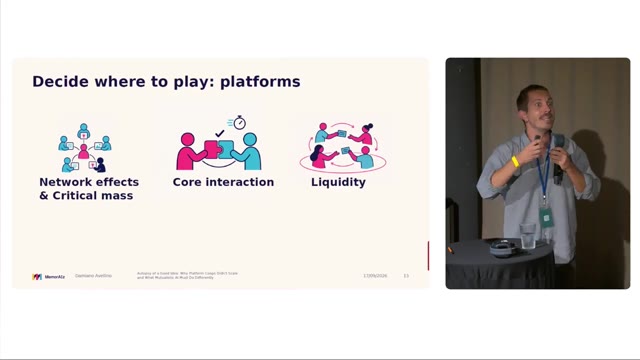
3:11Fairbnb’s publicity did not solve marketplace density and matching problems.
 1:02
1:02A share of profits and influence over dominant firms are separate questions.
 1:43
1:43Sharetribe’s founders retained voting control before a later democratic transition.
 2:09
2:09An API change exposed the recurring costs and legal responsibilities of shared data.
 2:36
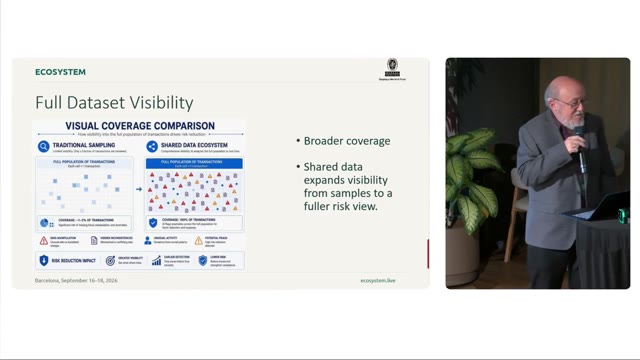
2:36More complete checks can reveal problems while creating a commercial penalty for the verifier.
Themes can overlap. Counts describe this collection; they do not measure importance, agreement or prevalence outside the event.